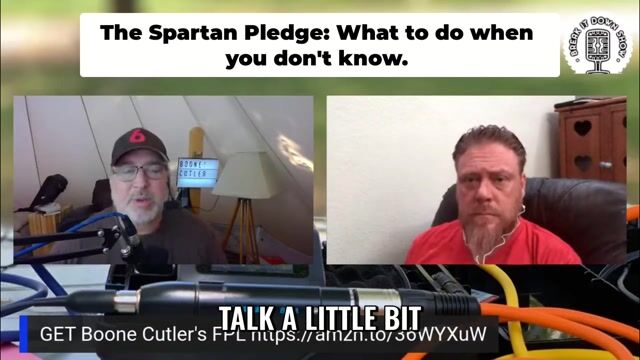
Spartan Pledge Your Battle Drill For Lifes Toughest Moments
wellnessBoone explains the Spartan Pledge — how it brings self-awareness and gives warfighters a drill for the moment they don't know what to do. It's not a promise to never take your life. It's a commitment to make one phone call before you do. That call breaks the tunnel vision. That's all it takes.
Share & Download
Transcript
So talk a little bit about the goal, the mission and the progress.
Well, the, what we do with the Spartan pledge, you know, basically brings
self-awareness to somebody.
And it also, uh, it gives, it gives that outlet because you take the Spartan
pledge, you don't take it because yourself, you might have a bad day.
You know, that's not why you take the Spartan pledge.
You take your Spartan pledge because you care about somebody else.
You have somebody close to you that, you know, at some point in time, they may
need to reach out for themselves.
And so you're saying ahead of time, Hey, if this happens, I'm the guy you call.
I'm the person.
So when you get into that histrionic state of mind, you really, you know,
can't wrap your head around anything other than what's negative.
You know, it becomes a battle drill.
The Spartan pledge is a battle drill.
It's what to do when you don't know what to do.
And you've already made the agreement with somebody else.
So when you get in that state of mind, you just pick up the phone.
And usually as soon as the call goes through the histrionic thinking stops,
it deviates, it diminishes, it dissolves.
And so that's why this is so important.
And the other part of the Spartan pledge is to maintain, it's to maintain a mission.
Because if you don't have a purpose in your life, you know, that's one reason I
think the suicide rate is really going up right now across the board is because
people don't have a sense of mission.
They're in their houses.
They're looking at their phone.
They only see people through zoom.
You know, it doesn't really feel like you can accomplish much if you're
always stuck behind four walls.
So, you know, that that's an issue.
So we like to say with the Spartan pledge, maintain a battle buddy and a mission
and everything else will work itself out.
You'll find a way.
Good news.
We've got some additional good news regarding the Spartan pledge.
It's now been modified for first responders and there's a first
responder Spartan pledge.
And just like for war fighters, there's a, there's a sword, a Spartan sword made
from the metal of the wreckage from the world trade center.
Now there's an ax and a first responder Spartan pledge.
And it's also made from the, from the metal, from the wreckage
of the world trade center.
So now we're, we're saturating different areas.
We're saturating first responders and we're saturating war fighters.
Wow.
That's cool, man.
That's, that's super neat.
How successful is it in terms of that?
I mean, it's one thing to have a pledge, you know, someone very, very, very close
to me attempted suicide recently, and I want them to have a Spartan pledge.
How, how does this work?
How do I help this person that's, you know, been on the edge of the building
before, you know, and that's figuratively speaking, not being exact here, but
someone who you're passionate to help, but you can only do things like, let's
set up a Spartan pledge, what does it work and how do you ensure that person
as much as possible will actually pick up that phone?
Well, I think the reason it works so well, I was asked if I could
adapt it to a junior high kids.
And I said, well, first of all, you got to, they have to understand, you
know, what an ethos is, because when you're making a pledge, a pledge means
nothing if a person doesn't have a personal ethos about themselves, the
way they carry themselves, something they believe in, it just doesn't work.
If, because if, if you have no standards and you make a promise and you don't,
then you're not going to keep your promise.
So you have to start with, with a group of people that believes in living by an
ethos and what do we have there?
We've got military and first responders by and large to serve a cause greater
than self, so I think the Spartan pledge works very well and that's why it's so
effective in our communities because it's tailored for people who serve a
cause greater than themselves.
It's basically taking the warrior ethos and flipping it on its head.
So that's why it's effective more than what you see, what they call suicide
contracts.
Like you sign a contract with your doctor that says, Oh, I won't commit suicide.
Well, that's anybody over, over some, over something that has no ethos attached
to it, a war fighter who's taken an oath, who understands what that means, who
understands how important that is, who understands the relationship with, with
that other person that goes through similar difficulties in their experiences
in combat.
Well, now that whole paradigm changes, we're not talking about some innocuous
signature on a piece of paper.
We're talking about something people care about, and I think that's why the
Spartan pledge works in our communities.
Can it be adapted to other places?
Yes.
Will it be as effective?
Probably not because, because they don't live by the same rules.
So an ethos is a good thing to have if you're young and to try to figure out
how to get one.
How does a young person develop an ethos?
I mean, how, like they don't even know enough to know enough.
What do they do to, to,
what does a parent do, you know, to give their kid an ethos?
Well, I think one, you know, leading by example, we talk in the military about
having a military bearing, you know, I mean, parents have to have a parental
bearing, you know, when they're with their children, how they conduct themselves.
I think, I think ethos comes from that, you know, just like you have a military
bearing as a non-commissioned officer, or even as an officer, you have to have a
parental bearing to raise a subordinate, to, to, to live by an ethos.
It's really not that, that much different.
My friend, Cindy, we grew up together.
She says, how does someone like me, a mom, non-military help with a Spartan pledge?
Well, talk about it.
You know, there's, there's videos.
I suggest you go on the, on social media and find videos and share those videos
and say, Hey, if you know somebody out there who's, who's in the military, if
you know a first responder, anybody who's struggling, share that information.
You never know where it's going to land.
And it usually at least makes people think if, even if you're not a
war fighter or first responder, you know, by reading the pledge, you go, Oh yeah,
I should just pick up the phone and call someone I trust.
So everybody's affected by it as soon as they see it.
So if you could just spread it around, that would, that does a lot of help.
And it usually lands in pretty interesting places.
I'm going to put a link here to a Spartan pledge.
You may recognize the subject in it.
It's a, it looks a lot like, so I'm going to put that up here on the, on the show notes.
One of the things that we have, it's sort of code backdoor code, at least for us army folks.
I could look at you and I say, Boone, how you doing?
You go, yeah, you know, I'm all right.
I'm just raving on or whatever.
And I'll say, Hey, integrity check.
What's going on?
You know, and I can say those two words and you know, it's time to cut through the
bullshit, cut through the ego actually makes me tear up a little bit and be honest and say,
you know, I, and whatever it is, whether it's like, you know, who did this, you know,
and if you check someone's integrity, it's on that person to have the backbone to say,
this is on me, or this is my honest, you know, this is where I'm being honest.
And that doesn't really exist necessarily in the civilian world where you feel, I mean,
literally like my eyes well up.
And I think about how important it is to check on someone or, you know, to, to just
get to the truth of something fast.
Yeah, I think there, it used to be, you know, if you swore on a Bible, I mean, that's,
that's, that's akin to, you know, integrity checking someone when you integrity check
somebody you're saying, Hey, would you basically be willing to bet the whole farm?
I mean, bet everything I believe in you on this one thing.
And I think it's important.
I don't think we have to, again, we don't have this eldership in our culture anymore,
where an older person would tell a younger person why it's important to tell the truth
and how it will affect their lives over the time we're getting information without
wisdom. So we have to, again, go back and teach young people why it's important to
seek wisdom.
And we've been going at this for about an hour.
I wanted to give you a chance to spin the mic around and ask me a couple of questions.
You've been busy. I've been busy.
What what do you want to ask me?
Are those birds I hear in the background?
I am in a tent in my backyard.
It's the studio and there is a small engine airplane flying overhead.
And there are for sure birds.
OK, OK, OK, my bad.
I got it. No, I was going to ask you, you were you were you've been working out.
You've been talking about fitness.
I saw some posts not long ago about that stuff.
How's how's that working out for you?
How are you feeling?
It's good. I've been battling a little bit lately.
To be honest, you know, a little depression, that kind of thing,
kind of letting the world overwhelm me.
And so I've not been to the pool, even though I know the minute I get out of the pool,
I feel like a million bucks.
I've been battling through that first bubble to get into the pool.
You know, so it's great when I do it.
And you'll appreciate this.
I swim with flippers on and a snorkel because that's what my body allows me to do
for a long time.
Like if I go out and I don't use flippers, I overuse my shoulders.
And then, you know, that already sounds bad.
And then when I don't use a snorkel, again, like by rotating my neck a bunch,
it just gets my shoulders all activated.
Continue the Journey
This video is part of a guided experience. Watch the full story in order.
Start the Wellness Journey →