Veterans Journey War Politics Psychedelics Modernization
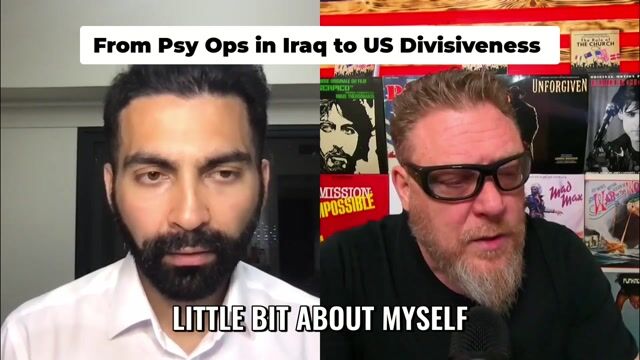
recovery"I served in Iraq. My job was psychological operations." Boone giving his background and connecting his wartime experience to the current fight — politics, psychedelics as medicine, and modernizing how we treat warfighters. The full arc from service to advocacy.
Share & Download
Transcript
A little bit about myself, I served in the United States military, I served in Iraq.
My job primarily in the military was psychological operations.
I was injured in Iraq.
When I got out of Iraq, I went into veteran advocacy and I started advocating for veterans
that were coming home from the war, different things like PTSD, suicide, different medical
treatments that work and were not really available at the time.
They still aren't available, but it's getting better because it seems so crazy sometimes.
Everything that we see, everything that we deal with, the amount of manipulation, whether
it's online or whether it's through the media or whether it's through our own politicians,
there's a lot of manipulation that goes on and I think it leaves people a sense of confusion.
So we just try to explain what's going on so they're less confused and they can make
better decisions and also keep their families together because there's a lot of divisiveness
that tears apart families.
And that was really one of the biggest motivators for us to do this, is that we're just talking
to so many families and I don't know what it's like where you're at, but in the States,
it's like a few years ago everybody just split, they just split in all these different directions
and it didn't make any sense.
And so we try to make sense of it.
I'm guessing that's probably similar for America with the Trump election in 2016, I'm guessing
that kind of thing.
It seems to be the same game wherever you go and I've been talking about how the United
States is going through this renaissance period.
Renaissance being the thing that connects the old to the new, there's a renaissance
happening in the United States and you're seeing that with Trump and right now we're
going through a modernization phase of our government.
I think that's a lot, everything that Elon Musk is doing right now in the United States
with Doge, the Department of Government Efficiency, a lot of that I think is going to, is the
primer, is the beginning part of understanding how we can modernize and make things more
efficient.
First we have to kind of get rid of whatever corruption that's in the system and then
we got to start fresh.
So it's a big deal, but you've also seen the same around the world.
You've seen populist movements just popping up everywhere.
I think part of that renaissance, I think that there is a counter Kissinger or a reverse
Kissinger move kind of happening right now with the U.S. and our allies in Europe.
For instance, for the United States, here's what I see.
We're kind of looking at NATO and the conflict between Ukraine and Russia and we're saying,
not me, but I think the United States is reassessing, saying that's not our primary target, that's
not our biggest threat and we don't have the resources to fight in Europe and in other
places.
But the U.S. looks at China as the primary threat and it's the primary threat that just
has not been addressed and for whatever reason, whether it's corruption within our own country,
whether people in our own country are somehow in a direct or indirect way, they have the
interest of China, of the CCP at hand more than they have the interest of the United
States at hand and so there's going to be opposition to that.
But again, our media would not show that, it would be showing a much more, it's almost
a crazy time in America where it's just all over the place.
That's what they're kind of portraying in the BBCs of the world, the sort of UK media
outlets.
They'll be saying that this is just chaos and it's just a group of people who are just
the first one that comes to their head, they're just doing it, there's no plan, that's what
we kind of hear.
With regards to the endless wars that I mentioned, you can't send people to war without the
intention of winning.
This is a real problem.
It affects morale and the national will of the people, the morale of people in the military
but also the national will of the citizenry of society in America, it affects them deeply.
And then it's hard, where I see the biggest consequence, the biggest consequence to all
that is that, okay, what happens when we really have to get into a war?
Because it truly does equal our survival as a nation.
And then the people are like, well, wait a minute, that's what you told me last time.
And that wasn't happening.
And then you've got military going, yeah, I'll do my job, that's what I'm here for,
I took an oath.
But that's what you told us last time and it wasn't true.
And so it's kind of like the boy who cried wolf, if you know that old story in America.
The boy cries wolf and all of a sudden the wolf's never there.
And then all of a sudden the wolf is there and nobody believes him.
And then there's this lack of trust in the government because of that.
Well, there's been a change.
Over through the Biden years, there was decreased in enlistment in the military.
I mean, it was very hard to get people to join the military.
And now that Trump has won his second election, the enlistments are way up.
The recruiters are not having the problems that they were having before.
And so this wokeness in and of itself, when that was being pushed in the military, it
turned away a lot of folks who would normally be attracted to that life and that lifestyle.
And again, Trump represents, Trump doesn't represent the Republican Party to most people.
He just happens to be a Republican.
Trump represents revolting against the system.
That is a common denominator in the United States right now.
So as part of that modernization phase, who can you rely on within that dime framework,
those levers of power?
Well, if you're changing your country from within to modernize it,
the easiest thing a president can do is focus on the economic factors, which is tariffs.
So I think this government or this administration is focusing on this modernization.
And instead of controlling, leveraging other countries with military or some sort of covert
operation, covert influence, they're going to focus on how to leverage them through money.
I want to touch on something you talked about there in terms of the information agencies
and these groups of people, because we've had on this show General Robert Spalding a few times,
who's talked a lot about the threats of China over the years.
We've had other people based in the States talk about the threat of China.
Why is there almost a lack of urgency or a lack of a group thinking on the threats of the CCP?
Because to me, it seems almost a few things that could be the reason why.
One being the kind of stuck in the stigma of Cold War mentality, which is Russia is the threat,
Russia is everything.
Russia is the enemy.
And the second part of me thinks, is there some corruption involved in the sense of,
it's so clear what China is doing across the globe, to be honest.
It's not that the United States took their eye off the ball.
I think it was very easy to maintain that Cold War Kissinger vector this entire time,
because it's what people are just used to.
And I think there have probably been a lot of people in a lot of different governments,
not just the United States, the US, Canada, UK.
I think there's a lot of people in a lot of different governments that have been influenced
either directly, indirectly, winningly, and unwittingly by the Chinese Communist Party.
And they focus a lot of their effort on political warfare.
We have not done the same.
We have not leveraged our levers of power, our assets, our resources, as effectively as the
CCP has.
And they want to win without fighting, period, end of story.
That's their game, to win without fighting, to collapse it from within,
to control it from the outside, so they don't have to fight.
These are all huge, huge factors that most people just are unaware of.
Cannabis is great for sleep.
I'm not talking about people getting high, sitting in the room all day playing video games.
I'm not talking about that.
I'm talking about wellness.
There is a time and a place.
Cannabis is 100% non-toxic to humans.
And I can tell you that both these things are based in fear, because the truth is that
psychedelics are very good for people who have been through any type of trauma,
through any type of addiction, who have unretractable depression.
You know, these are factors in people's wellness and lives every day.
And there's ways to help them that are not public, they're not mainstream.
Continue the Journey
This video is part of a guided experience. Watch the full story in order.
Start the Recovery Journey →