Veterans Tbi Ptsd Journey Hope Through Psychedelics Stem Cel
recovery"Boone Cutler, U.S. Army veteran who served in Iraq, has been open about the challenges and vulnerabilities he has faced." Interview covering Boone's full health arc — TBI, PTSD, psychedelics, stem cells. The path from broken to better, told by the man who walked it.
Share & Download
Transcript
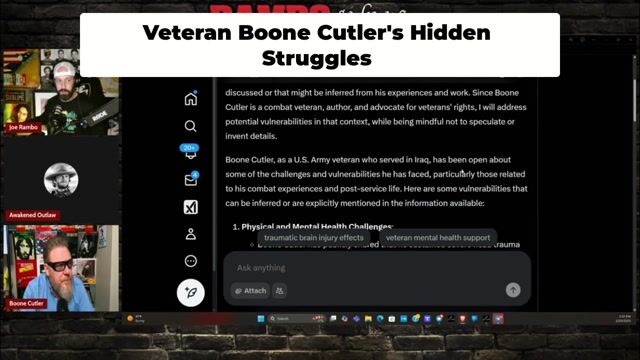
Boone Cutler, as a U.S.
Army veteran who has served in Iraq, has been open about some of the challenges
and vulnerabilities he has faced, particularly those related to his
combat experience and post service life.
Here are some vulnerabilities that can be inferred or are explicitly
mentioned in the information available.
I love it. Right.
It's deep, bro. I love it.
Physical and mental health challenges.
Boone Cutler has publicly shared that he sustained severe head trauma
from a mortar blast during his deployment in Sadar.
Did I pronounce that correct?
Sadar or Sader? Yeah.
Yeah. Sader city, Iraq.
This resulted in the traumatic brain injury TBI, which can lead to long term
physically cognitive and emotional vulnerabilities.
TBIs are known to cause issues such as memory problems, mood swings
and difficulty concentrating, which can impact their life and professional endeavors.
In 2012, he was diagnosed with an early onset Parkinson's disease, which has
which he attributes to wartime injury.
Parkinson's is a progressive neurological disorder that affects movement
and can lead to vulnerabilities such as tremors, stiffness and difficulties
with balancing coordination.
These physical limitations might affect his ability to engage
in certain activities or maintain the same level of physical independence over time.
Cutler has also discussed his struggles with post traumatic
stress disorder, PTSD, a common vulnerability among combat veterans.
PTSD can manifest as anxiety, flashbacks or emotional distress,
which might pose challenges in personal relationships,
public engagements or high stress situations.
This goes really deep, bro. You want me to keep going?
And I just think it's amazing.
Just scroll down real quick.
Public scrutiny, advocacy, risk. Keep going.
Just scroll down. That's pretty good.
And for everybody out there watching,
I hope you also look up my vulnerabilities.
I think it would be fantastic.
I just want to get all that out there in the in the front.
And you know, this is this is good for me because I oh, wait, what's this?
Well, not specific to Cutler, the search results on vulnerability
size, exploited vulnerabilities.
Remind us that public figures like him who maintain an online
presence, the radio, social media, blah, blah, blah.
Personal data are targeted.
It could be targeted by malicious actors,
especially given the visibility as a veteran advocate and media personality.
No way. No, I've never seen that before.
Yeah. Shocked. Golly, golly.
I love it. I hope everybody looks at my vulnerabilities and tries to exploit them.
I really do. It makes me that much stronger.
That's really funny.
You just you got it. You got to face it, man.
I mean, I talk about this stuff all the time.
I've seen plenty of time talking about PTSD.
And what it didn't throw in there is it didn't throw in there
my advocacy for psychedelic therapy and stem cell therapy.
And those are two things that have really resolved
a lot of the a lot of the things that I was dealing with daily.
You know, I mean, I still have issues with memory and concentration
and all that kind of stuff. That's an issue for me.
I can only like when we write, when General Flynn and I write,
I can only write like from five o'clock at night to like two o'clock
in the morning because I can't I can't deal with any distractions.
It just it throws me off.
I get distracted and I'm in the middle of writing something.
I'll forget like my train of thought and I can't get it back for a long time.
I have to go back through everything. It's very, very arduous.
But I just want to talk to everybody out there dealing with with TBI and PTSD.
You know, that's not a death sentence.
It's not a death sentence at all.
You know, there's there's ways that we learn to cope and overcome
with those overcome those things.
And and I do highly recommend psychedelic therapy and stem cell therapy.
If you're dealing with those types of stuff, it's not the easiest thing
to acquire in the United States.
You might have to go outside the country.
You know, I've been to Mexico several times.
I've been down to Panama to get stem cells.
And that's that's been that's been very helpful.
So I'll continue to advocate for that stuff, because, as you can see,
with my vulnerability list, it's quite lengthy.
And I know I know the guys out there deal with the same thing.
And if I can be that advocate who has been, you know,
I've been my own test crash dummy to try and figure this thing out.
And it's that's gone on a long time.
And if I didn't have the support of my beautiful wife, you know,
through the entire thing, I don't I don't think I could have got through it.
You know, there's a there's a strength in people that are
ready, willing and able to kind of throw open the old kimono
and let everybody see the words, right.
Imperfections. Yeah.
And for it.
And for me, it's kind of like, hey, hit me, come on, hit me.
You know, that PTSD thing.
That means I like that. Come on.
You know, let's go and send me, send me, send me.
But, you know, you got to you got to do that, you know?
I mean, you don't step in the ring unless you want to get in the fight.
And I think there's there's there's people that do that.
You guys both do that, you know, as as the digital war fighter,
as the digital warriors that you are, that's a that's a big deal.
And and I could see in this community,
there's been a lot of people that have taken hits.
And sometimes it's just these these what I call tabloids for hire,
you know, and they are they got the blue check, you know, they get engagement,
they get paid on engagement.
So they create controversy for engagement.
They're they're a tabloid.
And then you have full blown paid cutouts that are maybe working for agencies
or for foreign agencies.
And they're kind of mixed in that, too.
And then you've you've got the mentally ill folks,
because there's a lot of mentally ill folks that get on social media
that sound very, very credible.
They're they're they're so convinced themselves that they're convincing.
And people don't know enough to how to don't know enough to discern,
you know, these these types of environments.
So, you know, I talk about that a lot when I talk about tech discipline
and tech hygiene, because that's so important because you can, you know,
you get two, three schizophrenics on there that are are kind of piling down on you.
It can get a little dicey and and it can really kind of
manipulate people and put and take them down the wrong path.
So we've got to be aware of all these things.
So, OK, so Boone, so being aware is is
probably step number one, right?
You are a warfighter.
You're an army veteran.
You're an author that I absolutely look up to.
I can't wait to read everything that you write.
Fifth generation warfare is completely molded the way that I think
and the way that I discern the different things that are being thrown at me
from an information space.
What is it that we do?
Like, OK, so being aware is one thing.
But what is it that we do to to maintain some sort of
digital health when it comes to this whole thing?
Well, the first step, I do recommend everybody get the books
because there is a mental, the mental health aspects to the books,
because once you understand what's happening, soft imperative, number one,
you know, understanding your operational environment.
Once you understand what's happening and who's doing it
and how they do it and why they do it, that's where you learn how to discern.
And I often speak about something we wrote about in session two.
And that's that's what literacy is.
You know, what is literacy in today's world?
If this was 1920 America, literacy would be, can you read, write
and speak the same language as the person you're trying to communicate with?
That would be literacy in today's world.
Literacy means in this cyberspace that's happening is
you have to be able to determine if information is truthful, believable,
neither or both.
And this is where people get they get they get it twisted
because there's a lot of things that are believable
based upon your vulnerabilities and susceptibilities.
It's believable and people accept it as truth and then they run with it.
But believable does not mean truthful.
And so you have to be able to determine if something is truthful, believable,
neither or both.
And then from there and you do that by having a good solid awareness
of the different types of propaganda, you know, we're talking about white,
gray and black.
You do that by understanding how to conduct a little bit of open
source intelligence, a little bit of human intelligence, you know,
to find people that can give you the answers that are very straightforward
and true.
So it takes all this in today's world because we're in this information
overload. And I see it all the time on social media where people are just,
you know, sharing a post, sharing a post, sharing a post, sharing a post,
sharing a post. And it's just constant.
And they're not really, you know, there's IO fratricide.
That's what we call that information operation fratricide.
When when people immediately take these posts to heart
in an emotional space.
And then that kind of throws out, you know, that that critical thinking aspect.
Continue the Journey
This video is part of a guided experience. Watch the full story in order.
Start the Recovery Journey →