Warfare Evolution From Swords To Minds Explained
preparedness"Before I ask you about the five types of warfare, I have to recommend this book." Interviewer setting up Boone to walk through the evolution of warfare — pre-gunpowder to cognitive battlespace. The arc from swords to minds, generation by generation.
Share & Download
Transcript
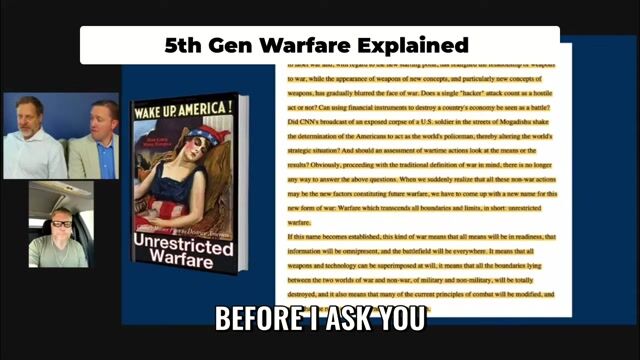
Before I ask you about the five types of warfare, I have to recommend this book. I first saw this on the Epoch Times, who I've done work for for a few years now, War Without Rules by former Brigadier General Robert Spalding. What this book does is it takes this book, Unrestricted Warfare, which even in the translation is a little bit unaccessible in parts because there's some metaphors that come from China that don't really translate. And it breaks it down. So I highly recommend that book. But, Boone, maybe you could tell us a little bit about what fifth generation warfare is. Sure, sure. And well, let's start this way. I'll do the fifth generation warfare, you know, the eras of war. And then I could talk a little bit about gray zone and nonlinear warfare and all the things that. that implies because it's what you're talking about. And it's very, very important, at least from my perspective, it's very important for people to understand the terminology because we can't have continuity of action till we have continuity of message. And that starts with understanding terminology. And there's a lot of people who use certain terminologies and it's maybe a little off or someone thinks, no, it's this thing, not that thing. And there's so much overlap in that whole nonlinear warfare space that you just, that's where we break it down into the fifth generation of war. You know, it's, And the fifth generation of war, specifically, just like we have generations of people, we've got boomers, we've got Gen Xers, we've got millennials, we've also had generations of war, and it's always based on technology. So the first generation of war was pre-gunpowder, right? We're looking at things like Braveheart, where people just pour onto a field and start beating the hell out of each other, stabbing each other, clubbing each other to death, pre-gunpowder, right? Post-gunpowder is the second generation of war. Now we see the people pouring out in the same fields, except they're shooting each other from across the field. That's going into the second generation of war. The third generation of war, the lethality of war starts really, really climbing. You're starting to see trench warfare. You're starting to see weapons put on machines like tanks and airplanes. You're starting to see long-range artillery. Again, the lethality of war gets very, very intense here. At the end of the third generation of war, now we're going into things like atomic warfare, lethality increasing, increasing, increasing, how to destroy entire countries by decimating the land, right? That's what we're talking about, by decimating the land and then ultimately occupying it. We go in the fourth generation of war. Now we start backing away from technology in some aspects. We start seeing things like state actors using non-state actors to achieve political ideological goals abroad. For instance, like terrorism. Terrorism is a big deal in the fourth generation. Now we get into the fifth generation of war. And now this is primarily in the cognitive battle space. Instead of like during the third generation of war where we're destroying land, now we're shaping the cognitive battle space of a country so they will change, so the populace will change that country from within.
Continue the Journey
This video is part of a guided experience. Watch the full story in order.
Start the Preparedness Journey →